


Rare Diagnostics
3-O-Methyldopa (3-OMD) — Dried Blood Spot Test
3-O-Methyldopa (3-OMD) — Dried Blood Spot Test
⚠️ Important — please read before ordering
The diagnostic services offered on this website are in vitro diagnostic tests intended to provide quantitative information on specific biochemical biomarkers. All results should be interpreted by a qualified healthcare professional — such as a physician, clinical geneticist, or metabolic specialist — in the context of the individual's clinical history and symptoms. These services are intended to support, not replace, medical consultation, diagnosis, or treatment. A positive, negative, or borderline result does not constitute a medical diagnosis. Rarediagnostics.eu is powered by Masdiag Sp. z o.o., a registered medical laboratory (podmiot leczniczy) operating under Polish and EU healthcare regulations.
Couldn't load pickup availability
Share
A targeted dried blood spot (DBS) test measuring 3-O-methyldopa (3-OMD) — the primary metabolite of L-DOPA. Used as a screening marker for aromatic L-amino acid
decarboxylase (AADC) deficiency and for monitoring L-DOPA-based therapy in patients with rare neurometabolic conditions. Available to patients and clinicians across the European Union.
What is the 3-OMD test?
3-O-methyldopa (3-OMD) is a metabolite formed during the metabolism of L-DOPA (levodopa) — a naturally occurring amino acid and the direct precursor to the neurotransmitter dopamine. When the enzyme responsible for converting L-DOPA into dopamine — aromatic L-amino acid decarboxylase (AADC) — is absent or severely deficient, L-DOPA accumulates and is instead converted to 3-OMD via an alternative metabolic pathway. This leads to significantly elevated levels of 3-OMD in the blood.
Measurement of 3-OMD from a dried blood spot sample provides a rapid, minimally invasive, and highly specific screening marker for AADC deficiency — one of the rarest and most severe inherited neurometabolic disorders.
The test is performed using liquid chromatography-tandem mass spectrometry (LC-MS/MS) at our specialist laboratory in Warsaw.
What is AADC deficiency?
Aromatic L-amino acid decarboxylase (AADC) deficiency is an ultra-rare inherited neurometabolic disorder caused by mutations in the DDC gene. It affects the biosynthesis of monoamine neurotransmitters — dopamine, serotonin, adrenaline, and noradrenaline — which are essential for motor function, autonomic regulation, and neurodevelopment.
AADC deficiency typically presents in infancy with:
- Severe hypotonia (low muscle tone)
- Oculogyric crises — involuntary upward deviation of the eyes
- Developmental delay and intellectual disability
- Autonomic dysfunction (temperature instability, excessive sweating, nasal congestion)
- Movement disorders
AADC deficiency is frequently misdiagnosed or diagnosed with significant delay due to its rarity and the overlap of its symptoms with other neurological conditions. Elevated 3-OMD in a dried blood spot sample is a key biochemical indicator of AADC deficiency and should prompt further confirmatory investigation.
Additional clinical applications
Monitoring L-DOPA therapy: In patients with AADC deficiency or other conditions treated with L-DOPA, 3-OMD levels reflect L-DOPA metabolism and can guide dose optimisation.
Differential diagnosis of movement disorders: Elevated 3-OMD may also be observed in other conditions affecting dopamine metabolism, supporting broader differential diagnostic workups.
Who is this test for?
- Infants or children with suspected AADC deficiency — hypotonia, oculogyric crises, developmental delay of unknown origin
- Patients already diagnosed with AADC deficiency — for regular therapeutic
monitoring - Patients on L-DOPA therapy — for treatment monitoring and dose adjustment
support - Clinicians and neurologists investigating neurotransmitter synthesis disorders
- Clinical geneticists seeking a rapid, non-invasive first-line screening marker
- Researchers studying dopamine metabolism or rare neurometabolic conditions
|
Price |
€60 |
|
Sample type |
Dried blood spot (DBS) — capillary blood |
|
Collection method |
Fingertip lancet (included in kit) |
|
Analytes measured |
3-O-methyldopa (3-OMD) |
|
Analytical method |
LC-MS/MS |
|
Turnaround time |
10 business days from sample receipt |
|
Kit delivery |
1–2 business days (EU) |
|
Report format |
PDF with quantitative results, reference ranges and interpretation |
|
Suitable for |
All ages including newborns |
Frequently Asked Questions
What does an elevated 3-OMD result mean? ▼
An elevated 3-OMD level is a strong biochemical indicator of AADC deficiency. It should always be interpreted by a specialist. Confirmatory testing — including CSF neurotransmitter analysis and genetic testing — is required for a definitive diagnosis.
Can this test diagnose AADC deficiency on its own? ▼
The 3-OMD DBS test is a highly sensitive screening marker, but confirmation requires additional investigations including CSF neurotransmitter analysis and molecular genetic testing.
Is the test suitable for monitoring treatment? ▼
Yes. In patients receiving L-DOPA therapy, regular 3-OMD monitoring provides valuable information about drug metabolism and can assist in dose optimisation.
Do I need a referral? ▼
No referral is required to order a test kit. Given the clinical complexity of AADC deficiency, we strongly recommend results are reviewed by a specialist.


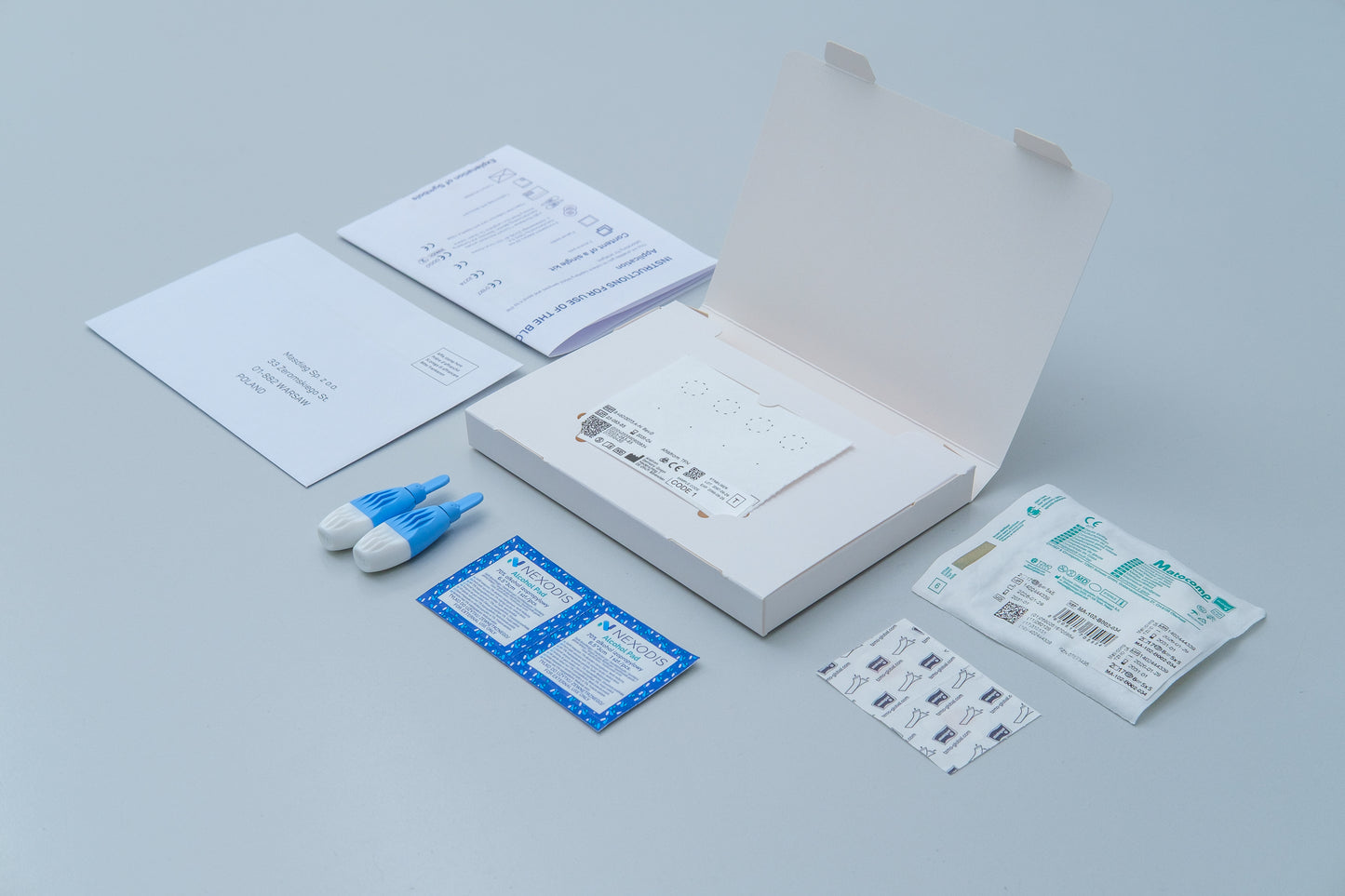
How does it work?
Step 1 — Order your test kit
Order online. Your DBS collection kit will be shipped to your address anywhere in the European Union, typically within 1–2 business days.
Step 2 — Collect your sample at home
Using the enclosed lancet, collect a few drops of capillary blood from your fingertip (or heel for newborns). Apply the drops to the filter paper card provided. Allow to dry at room temperature for 2–3 hours. No medical professional is required for collection.
Step 3 — Send your sample
Place the dried filter paper in the enclosed return envelope and send it to our laboratory in Warsaw. DBS samples are stable at room temperature and can be shipped across the EU without refrigeration.
Step 4 — Receive your results
Results are delivered within 10 business days of sample receipt. You will receive a detailed laboratory report with quantitative results and interpretive comments.