


Rare Diagnostics
Acylcarnitine Profile — Dried Blood Spot Test
Acylcarnitine Profile — Dried Blood Spot Test
⚠️ Important — please read before ordering
The diagnostic services offered on this website are in vitro diagnostic tests intended to provide quantitative information on specific biochemical biomarkers. All results should be interpreted by a qualified healthcare professional — such as a physician, clinical geneticist, or metabolic specialist — in the context of the individual's clinical history and symptoms. These services are intended to support, not replace, medical consultation, diagnosis, or treatment. A positive, negative, or borderline result does not constitute a medical diagnosis. Rarediagnostics.eu is powered by Masdiag Sp. z o.o., a registered medical laboratory (podmiot leczniczy) operating under Polish and EU healthcare regulations.
Couldn't load pickup availability
Share
A comprehensive acylcarnitine profile analysed from a single dried blood spot (DBS) collected at home. Used in the diagnosis and monitoring of fatty acid oxidation disorders, organic acidemias, and other inherited metabolic conditions. Suitable for all ages including newborns. Available to patients and clinicians across the European Union.
What is the Acylcarnitine Profile test?
The acylcarnitine profile is one of the most important biochemical tests in the diagnosis of inherited metabolic disorders (IMD). It measures the levels of carnitine and its esters — acylcarnitines — in the blood, providing a detailed picture of how the body processes fats and certain amino acids at the cellular level.
Carnitine plays a critical role in human metabolism. It acts as a transporter, carrying long- chain fatty acids into the mitochondria — the cell’s energy-producing structures — where they are broken down to generate energy. When specific enzymes in this process are absent or deficient, characteristic acylcarnitines accumulate in the blood. These patterns serve as precise biochemical markers that allow our laboratory to identify which metabolic pathway is affected.
This test is performed using liquid chromatography-tandem mass spectrometry (LC-MS/MS) — the gold standard analytical technique in metabolic diagnostics, offering exceptional sensitivity and specificity.
Which rare diseases can this test detect or monitor?
Fatty acid oxidation disorders (FAODs):
- MCAD deficiency (Medium-chain acyl-CoA dehydrogenase deficiency)
- VLCAD deficiency (Very long-chain acyl-CoA dehydrogenase deficiency)
- LCHAD deficiency (Long-chain 3-hydroxyacyl-CoA dehydrogenase deficiency)
- SCAD deficiency (Short-chain acyl-CoA dehydrogenase deficiency)
- CPT-I and CPT-II deficiency (Carnitine palmitoyltransferase deficiency)
- CACT deficiency (Carnitine-acylcarnitine translocase deficiency)
- Multiple acyl-CoA dehydrogenase deficiency (MADD / Glutaric aciduria type II)
Organic acidemias:
- Propionic acidemia (PA)
- Methylmalonic acidemia (MMA)
- Isovaleric acidemia (IVA)
- Glutaric aciduria type I (GA-I)
- 3-Methylcrotonyl-CoA carboxylase deficiency (3-MCC)
- 3-Methylglutaconic aciduria
Carnitine metabolism disorders:
- Primary carnitine deficiency (Systemic carnitine deficiency)
- Secondary carnitine deficiency
This test is also valuable for monitoring patients with known diagnoses, assessing dietary compliance, and evaluating the effectiveness of carnitine supplementation or dietary management.
What does the test measure?
The acylcarnitine profile quantifies free carnitine and 23 acylcarnitine species:
C0 (free carnitine), C2 (acetylcarnitine), C3 (propionylcarnitine), C3DC (malonylcarnitine), C4 (butyrylcarnitine / isobutyrylcarnitine), C4-OH (3-hydroxybutyrylcarnitine / 3-hydroxyisobutyrylcarnitine), C4DC (methylmalonylcarnitine / succinylcarnitine), C5:1 (tiglylcarnitine / methylcrotonylcarnitine), C5 (isovalerylcarnitine / valerylcarnitine / 2-methylbutyrylcarnitine / pivaloylcarnitine), C5-OH (3-hydroxyisovalerylcarnitine / 2-methyl-3-hydroxybutyrylcarnitine), C5DC (glutarylcarnitine), C6 (hexanoylcarnitine), C6DC (adipylcarnitine / methylglutarylcarnitine), C8 (octanoylcarnitine), C10:2 (decadienoylcarnitine), C10 (decanoylcarnitine), C12 (dodecanoylcarnitine), C14 (myristoylcarnitine), C14:1 (tetradecenoylcarnitine), C16 (palmitoylcarnitine), C16-OH (3-hydroxypalmitoylcarnitine), C18:1 (oleoylcarnitine), C18 (stearoylcarnitine), C18-OH (3-hydroxystearoylcarnitine).
Who is this test for?
- Patients with a suspected or confirmed diagnosis of a fatty acid oxidation disorder or organic acidemia
- Children or adults experiencing episodes of hypoglycaemia, muscle weakness, or metabolic crises of unknown origin
- Patients on carnitine supplementation therapy — for treatment monitoring
- Newborns or infants with abnormal newborn screening results requiring confirmatory testing
- Patients already diagnosed with an IMD — for ongoing disease monitoring
- Clinicians and geneticists requiring biochemical confirmation or follow-up data
- Researchers studying fatty acid metabolism or organic acid disorders
|
Price |
€130 |
|
Sample type |
Dried blood spot (DBS) — capillary blood |
|
Collection method |
Fingertip lancet (included in kit) |
|
Analytical method |
LC-MS/MS |
|
Turnaround time |
10 business days from sample receipt |
|
Kit delivery |
1–2 business days (EU) |
|
Report format |
PDF with quantitative results, reference ranges and interpretation |
|
Suitable for |
All ages including newborns |
Frequently Asked Questions
Do I need a doctor's referral to order this test? ▼
No referral is required to order a test kit. However, we strongly recommend that results are interpreted in consultation with a physician, clinical geneticist, or metabolic specialist.
Is the DBS collection method suitable for newborns? ▼
Yes. Blood can be collected from the heel of a newborn using the lancet provided. This is the same technique used in national newborn screening programmes worldwide.
How do I ship the sample internationally? ▼
Dried blood spot samples are stable at room temperature and can be sent by standard post or courier without refrigeration. Detailed shipping instructions are included in every kit.
Can this test be used to monitor a known diagnosis? ▼
Yes. The acylcarnitine profile is widely used for ongoing monitoring of patients with fatty acid oxidation disorders and organic acidemias, as well as for assessing carnitine supplementation therapy.
How will I receive my results? ▼
Results are delivered as a PDF report sent to the email address provided at the time of ordering.
I am a clinician — can I order tests for multiple patients? ▼
Yes. We offer institutional and bulk ordering for clinicians and research institutions. Please contact us for details.


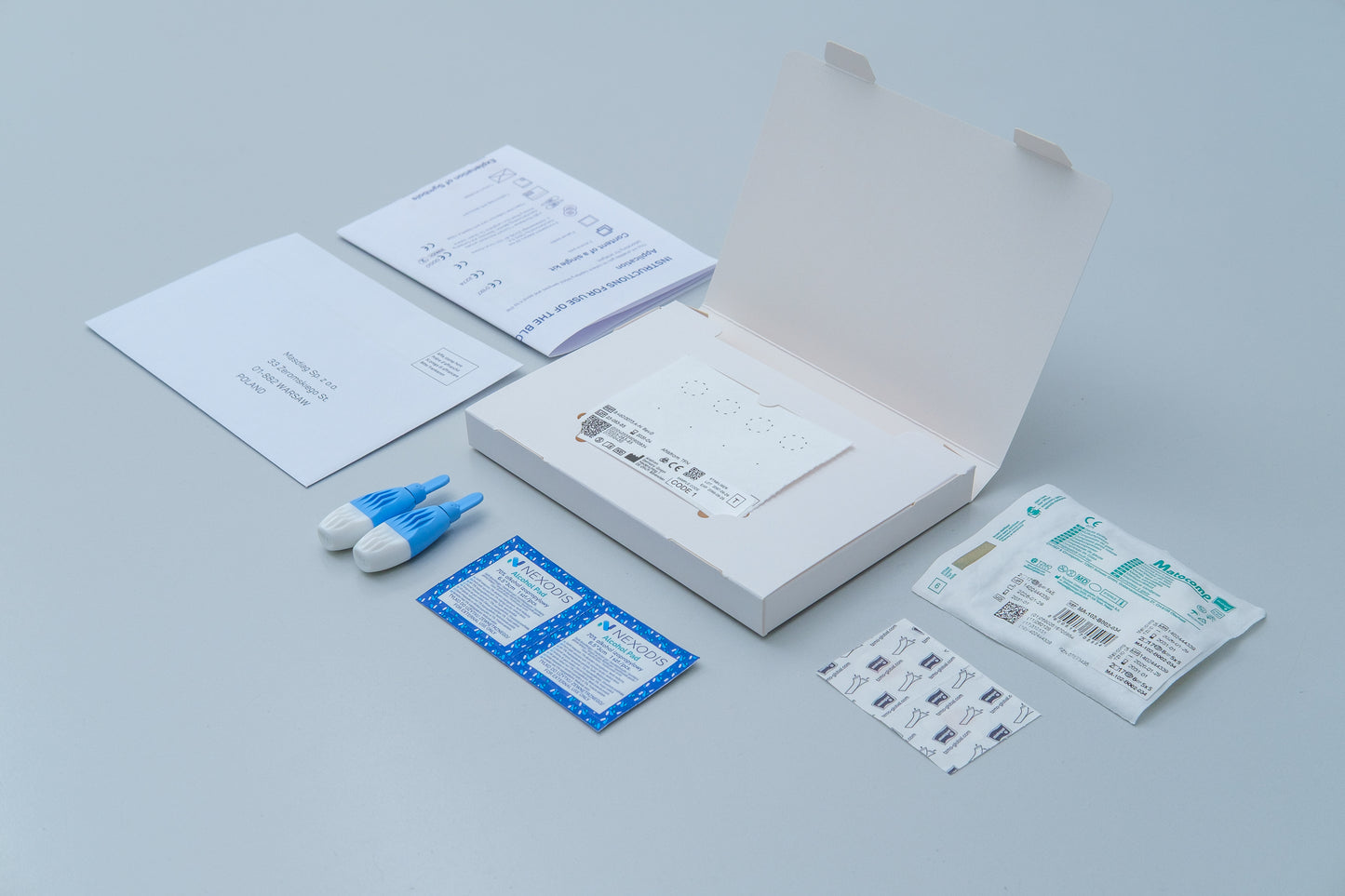
How does it work?
Step 1 — Order your test kit
Order online. Your DBS collection kit will be shipped to your address anywhere in the European Union, typically within 1–2 business days.
Step 2 — Collect your sample at home
Using the enclosed lancet, collect a few drops of capillary blood from your fingertip (or heel for newborns). Apply the drops to the filter paper card provided. Allow to dry at room temperature for 2–3 hours. No medical professional is required for collection.
Step 3 — Send your sample
Place the dried filter paper in the enclosed return envelope and send it to our laboratory in Warsaw. DBS samples are stable at room temperature and can be shipped across the EU without refrigeration.
Step 4 — Receive your results
Results are delivered within 10 business days of sample receipt. You will receive a detailed laboratory report with quantitative results and interpretive comments.