


Rare Diagnostics
Amino Acid Profile — Dried Blood Spot Test
Amino Acid Profile — Dried Blood Spot Test
⚠️ Important — please read before ordering
The diagnostic services offered on this website are in vitro diagnostic tests intended to provide quantitative information on specific biochemical biomarkers. All results should be interpreted by a qualified healthcare professional — such as a physician, clinical geneticist, or metabolic specialist — in the context of the individual's clinical history and symptoms. These services are intended to support, not replace, medical consultation, diagnosis, or treatment. A positive, negative, or borderline result does not constitute a medical diagnosis. Rarediagnostics.eu is powered by Masdiag Sp. z o.o., a registered medical laboratory (podmiot leczniczy) operating under Polish and EU healthcare regulations.
Couldn't load pickup availability
Share
A comprehensive amino acid profile analysed from a single dried blood spot (DBS) collected at home. Used in the diagnosis and monitoring of aminoacidopathies, urea cycle disorders, and other inherited metabolic conditions affecting amino acid metabolism. Suitable for all ages including newborns. Available to patients and clinicians across the European Union.
What is the Amino Acid Profile test?
Amino acids are the fundamental building blocks of life. They are involved in virtually every biological process in the human body — from the production of proteins, hormones and neurotransmitters, to the detoxification of ammonia, the regulation of blood sugar, and the support of immune function.
When inherited defects affect the enzymes responsible for amino acid metabolism, characteristic amino acids accumulate or become depleted in the blood. These biochemical patterns serve as precise diagnostic markers, allowing our laboratory to identify specific rare metabolic conditions with high accuracy.
The amino acid profile measures the levels of 26 individual amino acids in a single dried blood spot sample, using liquid chromatography-tandem mass spectrometry (LC-MS/MS) — the gold standard analytical technique in metabolic diagnostics.
Which rare diseases can this test detect or monitor?
Aminoacidopathies:
- Phenylketonuria (PKU) and hyperphenylalaninaemia
- Tyrosinaemia type I, II and III
- Maple syrup urine disease (MSUD) — branched-chain amino acid metabolism
- Homocystinuria (classical and vitamin B6-responsive)
- Non-ketotic hyperglycinaemia (NKH / glycine encephalopathy)
- Hyperprolinaemia type I and II
- Lysinuric protein intolerance (LPI)
- Cystinuria
Urea cycle disorders (UCDs):
- Ornithine transcarbamylase deficiency (OTC deficiency)
- Argininosuccinic aciduria (ASA)
- Citrullinaemia type I and II
- Argininaemia
- Carbamyl phosphate synthetase deficiency (CPS1 deficiency)
- N-acetylglutamate synthase deficiency (NAGS deficiency)
Other conditions:
- Hyperammonaemia of various origins
- Serine biosynthesis defects
- Disorders of sulphur amino acid metabolism
- Glutamine synthetase deficiency
What does the test measure?
The amino acid profile quantifies 26 amino acids and related metabolites in blood:
Alanine, Arginine, Asparagine, Beta-alanine, Citrulline, Phenylalanine, Glycine, Glutamine, Histidine, Homoarginine, Isoleucine, Aspartic acid, Gamma-aminobutyric acid (GABA), Glutamic acid, Leucine, Lysine, Methionine, Ornithine, Proline, Sarcosine, Serine, Taurine, Threonine, Tryptophan, Tyrosine, Valine.
Our panel includes several analytes not routinely measured by general laboratories, such as GABA, beta-alanine, sarcosine and taurine — providing a more complete picture of amino acid metabolism and a diagnostic advantage in complex or atypical presentations.
Who is this test for?
- Patients with a suspected or confirmed diagnosis of an aminoacidopathy or urea cycle disorder
- Newborns or infants with abnormal newborn screening results requiring confirmatory testing
- Children or adults with unexplained developmental delay, intellectual disability, or neurological symptoms
- Patients on therapeutic amino acid-restricted diets — for treatment monitoring
- Patients with recurrent episodes of hyperammonaemia or unexplained metabolic
crises - Clinicians and geneticists requiring biochemical confirmation or follow-up data
- Researchers studying amino acid metabolism or rare metabolic conditions
|
Price |
€70 |
|
Sample type |
Dried blood spot (DBS) — capillary blood |
|
Collection method |
Fingertip lancet (included in kit) |
|
Analytes measured |
26 amino acids and related metabolites (full list above) |
|
Analytical method |
LC-MS/MS |
|
Turnaround time |
10 business days from sample receipt |
|
Kit delivery |
1–2 business days (EU) |
|
Report format |
PDF with quantitative results, reference ranges and interpretation |
|
Suitable for |
All ages including newborns |
Frequently Asked Questions
Do I need a doctor's referral? ▼
No referral is required. However, we strongly recommend results are interpreted by a specialist.
Is this test suitable for monitoring dietary treatment in PKU? ▼
Yes. The amino acid profile is widely used for monitoring phenylalanine and tyrosine levels in patients with phenylketonuria on restricted diets.
Can this test detect urea cycle disorders? ▼
Yes. Several amino acids — including citrulline, arginine, ornithine, argininosuccinate and glutamine — are key markers for urea cycle disorders.
Can this test be combined with the acylcarnitine profile? ▼
Yes — and we strongly recommend ordering both tests together when investigating suspected inherited metabolic disorders. Together they provide a comprehensive first-line metabolic screen. Please contact us about combined test ordering.
I am a clinician — can I order tests for multiple patients? ▼
Yes. We offer institutional and bulk ordering. Please contact us for details.


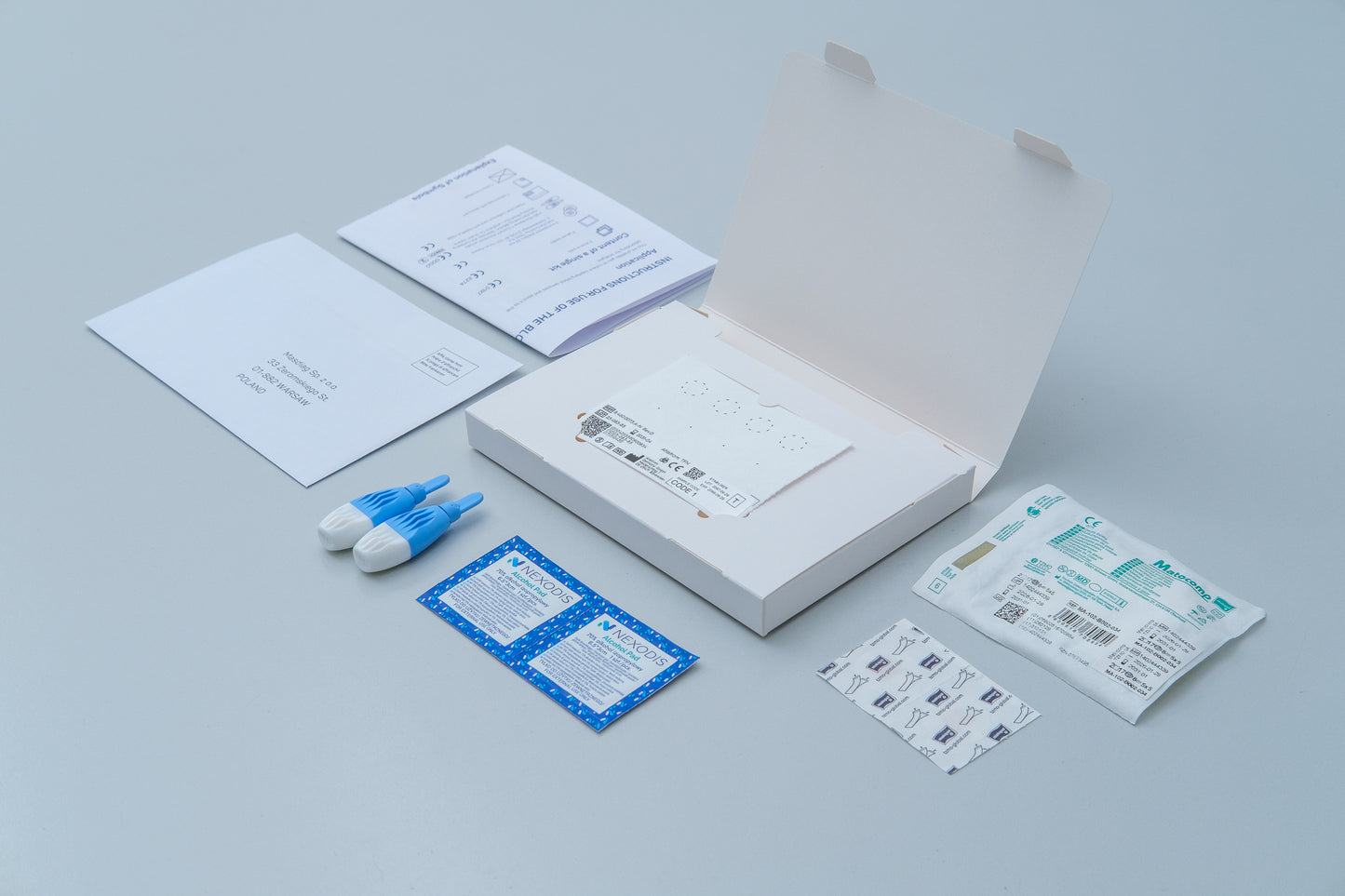
How does it work?
Step 1 — Order your test kit
Order online. Your DBS collection kit will be shipped to your address anywhere in the European Union, typically within 1–2 business days.
Step 2 — Collect your sample at home
Using the enclosed lancet, collect a few drops of capillary blood from your fingertip (or heel for newborns). Apply the drops to the filter paper card provided. Allow to dry at room temperature for 2–3 hours. No medical professional is required for collection.
Step 3 — Send your sample
Place the dried filter paper in the enclosed return envelope and send it to our laboratory in Warsaw. DBS samples are stable at room temperature and can be shipped across the EU without refrigeration.
Step 4 — Receive your results
Results are delivered within 10 business days of sample receipt. You will receive a detailed laboratory report with quantitative results and interpretive comments.